
When Audemars Piguet introduced the Royal Oak Offshore, reactions were divided.
Some saw it as excessive, others as revolutionary.
What no one could deny was that it altered the conversation around what a luxury sports watch could be.
Larger, heavier, more assertive—the Offshore did not ask for approval. It claimed space on the wrist, and in doing so, it created an entirely new dimension within the AP lineage.
That same spirit is precisely why the Offshore has become such an important reference point in the replica world.
Unlike classic Royal Oak models, which rely on restraint and balance, the Offshore exposes weaknesses immediately.
If proportions are off, if finishing lacks discipline, or if the case construction feels hollow, the watch fails the moment it is worn.
Why the Offshore Is a True Test of Replica Craftsmanship
For experienced collectors, Offshore replicas serve almost as diagnostic tools.
They reveal the capabilities—and limitations—of the workshop that produced them.
The reasons are simple but unforgiving:
- Multi-layer case construction with complex transitions
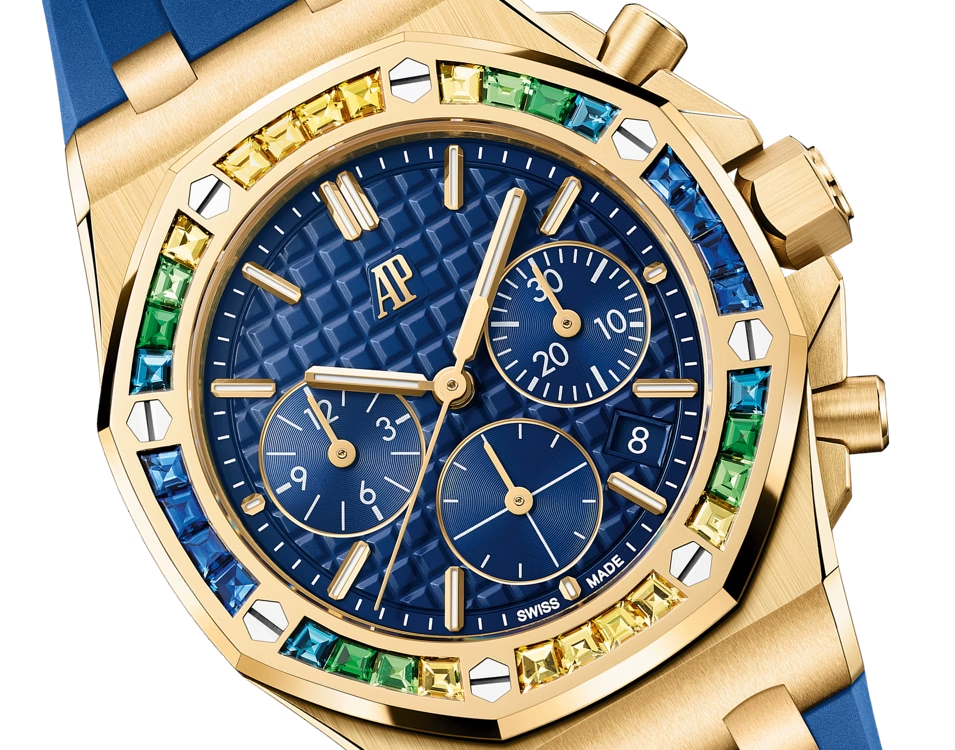
- Chronograph layouts that must align visually and mechanically
- Integrated rubber or hybrid straps that must feel intentional
- Case thickness that must remain powerful without becoming clumsy
A replica that gets these elements right earns immediate respect.
One that does not is dismissed just as quickly.
This binary outcome is why many collectors quietly judge replica makers not by their Royal Oak releases, but by how well they execute Offshore models.
The Shift Toward Heavier, More Honest Replicas
In earlier years, many AP replicas—Offshore models included—suffered from an imbalance between appearance and substance.
Cases looked large but felt light.
Chronograph pushers looked functional but lacked confidence.
Over time, however, the better factories adapted.
Modern Offshore replicas now focus on mass, density, and tactile presence.
When you pick one up, it should feel deliberate.
When you strap it on, it should settle rather than float.
These sensations may sound abstract, but collectors notice them instantly, often without being able to explain why a particular piece feels “right.”
Learning Through Contrast: Offshore vs Classic Royal Oak
One of the most interesting aspects of studying AP replicas is comparing Offshore models with their slimmer Royal Oak counterparts.
Doing so reveals how versatile Gérald Genta’s original design language truly was.
The same architectural DNA can express elegance in one form and aggression in another.
For many enthusiasts, wearing both styles—often in replica form—clarifies personal taste.
Some realise they prefer the measured confidence of a 41mm Royal Oak.
Others discover that the Offshore’s unapologetic presence suits their daily rhythm better.
In both cases, replicas function not as replacements, but as exploratory tools.
Where Collectors Turn for Focused Offshore Insight
As Offshore replicas have improved, the demand for clearer, more specific information has grown.
General descriptions and recycled marketing phrases no longer satisfy collectors who want to understand case architecture, movement choices, and factory differences.
While researching recent Offshore releases, I came across a resource that approaches AP replicas with a noticeably analytical tone, particularly when it comes to Royal Oak Offshore models.
Instead of broad claims, it focuses on structure, execution, and long-term wear experience.
For those interested in that level of detail, this reference is worth exploring:
Audemars Piguet replica Offshore analysis and reviews.
For general orientation, I also saved the homepage for future reference:
https://www.audemarswatches.com
A Different Kind of Appreciation
The Royal Oak Offshore was never meant to please everyone.
It was meant to challenge expectations.
That same quality is what makes it so valuable in the replica landscape today.
A good Offshore replica forces both maker and wearer to confront design honestly—without hiding behind subtlety.
In that sense, Offshore replicas occupy a unique position.
They are not about understatement or quiet elegance.
They are about commitment: to size, to weight, to presence, and to the idea that luxury can be bold without being careless.
For collectors willing to engage with that idea, the Offshore offers something rare—a way to understand Audemars Piguet not only as a historic manufacturer, but as a brand unafraid to push its own boundaries.
And sometimes, the best way to grasp that philosophy is not by reading about it, but by wearing it—day after day—until the design speaks for itself.